AI Upscaling in Gaming Beyond PSSR2: The Next Leap in Graphics Technology
By Abdus Salam
731 Views
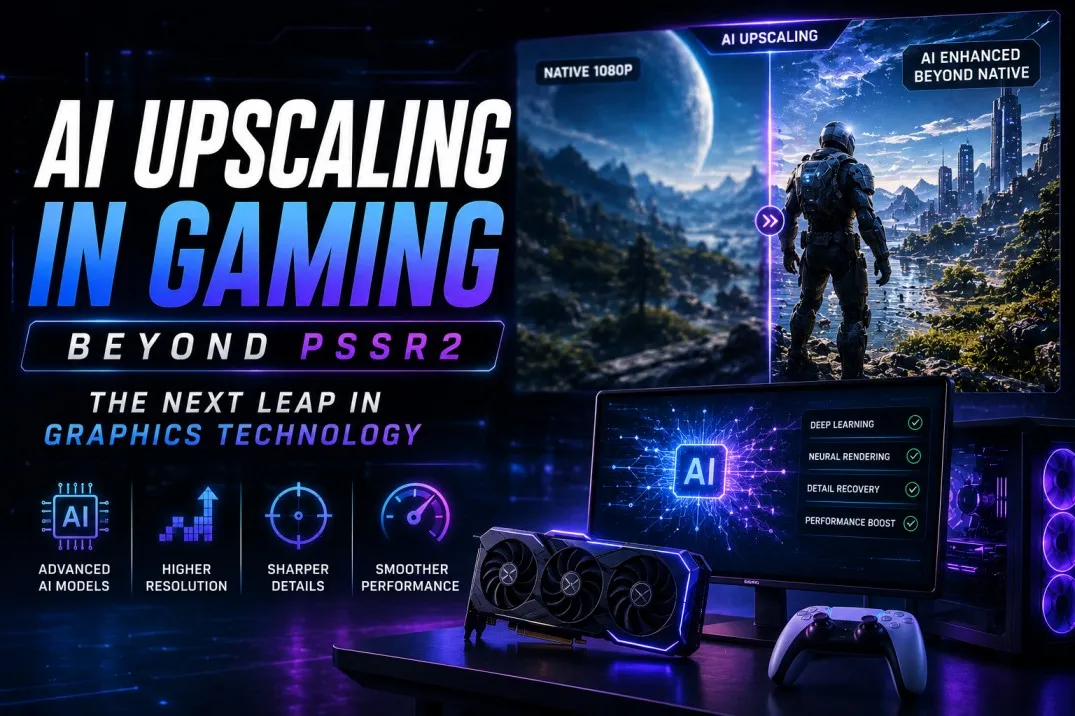
Gaming graphics have reached a level where traditional rendering methods are no longer enough to push performance and visual quality further at the same time. This is where AI upscaling technologies like PSSR2 and DLSS have changed the game.
But the evolution does not stop here. The future of AI upscaling in gaming goes far beyond current systems. Developers are now exploring next-generation neural rendering techniques that could completely redefine how games are displayed in real time.
In this article, we will explore how AI upscaling is evolving beyond PSSR2, what future technologies may look like, and how they will impact gaming performance and visuals.
What Is AI Upscaling in Gaming?
AI upscaling is a technology that enhances lower-resolution images into higher-quality visuals using machine learning algorithms.
Instead of rendering every frame at full resolution, the system:
- Renders a lower-resolution image
- Uses AI models to reconstruct details
- Outputs a sharper, higher-quality final image
This allows games to run faster while still looking visually impressive.
Limitations of Current AI Upscaling (PSSR2 and Similar Tech)
While technologies like PSSR2 have improved gaming visuals significantly, they still have limitations:
Motion Artifacts
Fast-moving scenes may sometimes produce minor blurring or ghosting.
Game-Specific Optimization
Each game may require fine-tuning for best results.
Hardware Dependency
Performance depends heavily on console or GPU capabilities.
What Comes After PSSR2?
The next generation of AI upscaling will likely focus on more advanced neural rendering systems.
1. Real-Time Neural Rendering
Instead of enhancing frames after rendering, AI will generate parts of the scene directly.
2. Scene Prediction Technology
AI will predict future frames based on player movement for smoother transitions.
3. Fully Adaptive Resolution Systems
Games will dynamically adjust resolution at pixel level depending on scene complexity.
Future AI Upscaling Technologies
Neural Frame Synthesis
AI will create entire frames between rendered frames for ultra-smooth gameplay.
Context-Aware Rendering
Systems will understand game environments and prioritize visual focus areas.
Deep Learning Scene Reconstruction
AI will reconstruct environments with near-photorealistic accuracy in real time.
Real-World Gaming Scenario
Imagine playing a fast-paced action game:
- Your movement is instantly analyzed by AI
- Frames are generated ahead of time
- Even during explosive scenes, visuals remain sharp and stable
- Frame drops become almost unnoticeable
This is the direction AI upscaling is moving toward.
Impact on Gaming Performance
Higher FPS Without Hardware Upgrade
Games will run smoother even on mid-range systems.
Improved Visual Stability
Less tearing, stuttering, and blurring in motion-heavy scenes.
Better Accessibility
More players will experience high-end graphics without expensive hardware.
AI Upscaling vs Traditional Rendering
Traditional Rendering
- Fully rendered frames
- High GPU usage
- Fixed performance limits
AI Upscaling
- Partial rendering + AI reconstruction
- Lower GPU load
- Adaptive performance scaling
AI clearly offers a more efficient future path.
Challenges Ahead
Despite strong potential, future AI upscaling still faces challenges:
- Training data requirements
- Risk of visual inaccuracies
- Developer integration complexity
- Hardware compatibility limitations
Expert Insight
AI upscaling is becoming more than just a performance tool. It is evolving into a core part of game engine design. In the future, AI may not just enhance graphics but actually participate in generating them.
This shift will redefine the relationship between hardware, software, and visual design in gaming.
FAQ
1. What is AI upscaling in gaming?
It is a technology that uses AI to enhance lower-resolution images into higher-quality visuals.
2. How is future AI upscaling different from PSSR2?
Future systems will use neural rendering and frame prediction instead of simple enhancement.
3. Does AI upscaling improve FPS?
Yes, it reduces GPU workload and improves performance.
4. Will AI replace GPUs in gaming?
No, but it will significantly reduce dependency on raw GPU power.
5. Is AI upscaling used in all games?
Not yet, it depends on developer integration.
Conclusion
AI upscaling beyond PSSR2 represents the next major evolution in gaming graphics technology. As neural networks become more advanced, games will not only look better but also run more efficiently across a wide range of devices.
The future of gaming visuals will be defined by intelligence, not just hardware power.